


Why on earth is it impossible to access sites like Newgrounds on Firefox but works fine on anything else?
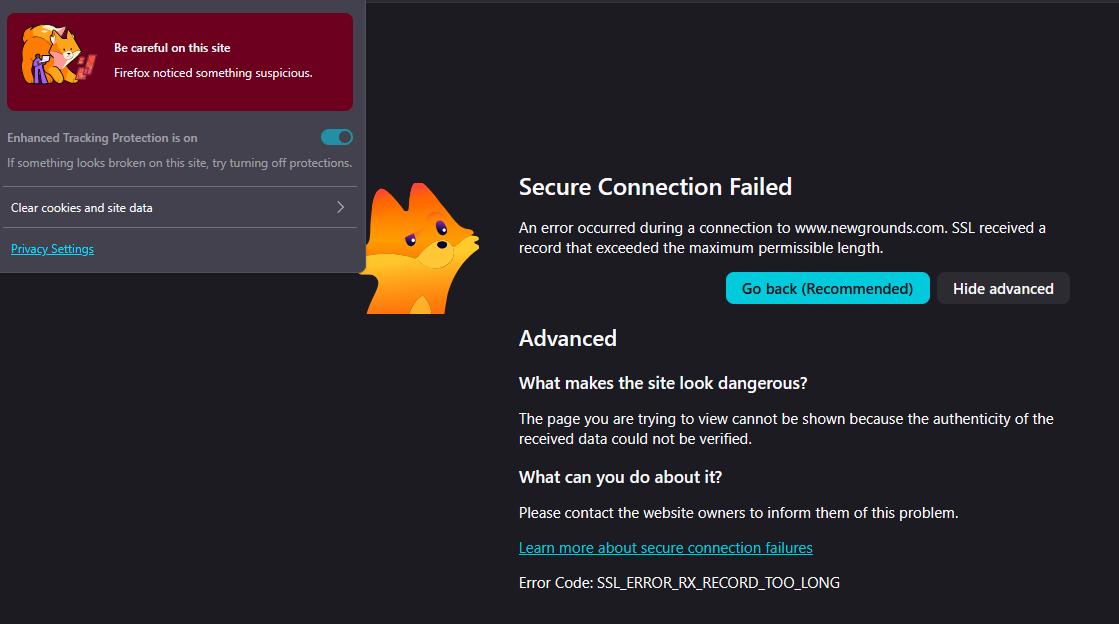
Heyo! So, I've had this ongoing issue with Firefox for quite some time around trying to access the Newgrounds website, but failing to do so. I have tried several things such as disabling the enhanced tracking setting, disabling DNS over HTTPS, forcing cookies and third-party popups to be allowed but that does not work what so ever and disabling enhanced tracking is greyed out so it's not even clickable to toggle off.
One thing that did work was to use the built-in VPN, but I really don't want to constantly have to use a VPN to browse one singular site every time I want to access it. So now for the question. Has anyone else experienced this? And if you have, how did you solve it if at all?
Chosen Solution
The console error just says the tampering you're trying to do is specifically configured by the site to not be allowed, so it does not load on security grounds and fails. That's not really interesting.
If you're able to connect via mobile hotspot, it means something on the line of your normal connection is doing weird things. Check if your router/modem has any "security" or "privacy" features that you can disable, or perhaps start with rebooting the router in the first place.
എല്ലാ മറുപടികളും (5)
SSL_ERROR_RX_RECORD_TOO_LONG both on Earth and elsewhere alike usually points to "garbage" being received on the secure connection. The server could trigger it based on session/account data (so it's good to check in Private Window or in a separate testing profile), it could be a bad redirection cached or sent from the CDN or their bot protections (non–secure content stuffed into secure line), or a local antivirus and similar poking its nose into the connection.
The VPN/proxy can help limit the amount of poking along the line, and also force different datacenter delivery since the client requesting the site is now in a different physical location.
These usually go away over time, or if you switch to a different network (like a mobile hotspot) avoiding your current appliances you might get different results. (Or just try changing your DNS–over–HTTPS providers, which also tend to help get content served from different location.)
Some prior threads:
jbr said
SSL_ERROR_RX_RECORD_TOO_LONG both on Earth and elsewhere alike usually points to "garbage" being received on the secure connection. The server could trigger it based on session/account data (so it's good to check in Private Window or in a separate testing profile), it could be a bad redirection cached or sent from the CDN or their bot protections (non–secure content stuffed into secure line), or a local antivirus and similar poking its nose into the connection. The VPN/proxy can help limit the amount of poking along the line, and also force different datacenter delivery since the client requesting the site is now in a different physical location. These usually go away over time, or if you switch to a different network (like a mobile hotspot) avoiding your current appliances you might get different results. (Or just try changing your DNS–over–HTTPS providers, which also tend to help get content served from different location.) Some prior threads:
I did try checking the things above to see if it worked or not, which nothing did other than the VPN of course and changing to hotspot. I also found some other potential information attached below I do not know if this may help or not as I have really got little to no idea how this works, but I opened the console in the browser and checked the network tab to see if anything there could be useful information, and thus I found out that I could use the blocked "get" method as a fetch in the console, which I then did. And as seen in the image below, this is the error it produces.

Chosen Solution
The console error just says the tampering you're trying to do is specifically configured by the site to not be allowed, so it does not load on security grounds and fails. That's not really interesting.
If you're able to connect via mobile hotspot, it means something on the line of your normal connection is doing weird things. Check if your router/modem has any "security" or "privacy" features that you can disable, or perhaps start with rebooting the router in the first place.
jbr said
The console error just says the tampering you're trying to do is specifically configured by the site to not be allowed, so it does not load on security grounds and fails. That's not really interesting. If you're able to connect via mobile hotspot, it means something on the line of your normal connection is doing weird things. Check if your router/modem has any "security" or "privacy" features that you can disable, or perhaps start with rebooting the router in the first place.
Will do! If it doesn't work then I'll just have to stick to hotspot I guess. Thanks either way for the help!
I know this is not great, and the error sounds cryptic — but it basically says:
- this was requested as secure, the site expects secure, and I've opened a secure link
- what comes back is not the agreed schema how we can negotiate connection params to encrypt the line, instead there's something unstructured, garbled, and not relevant for this communication
- whatever it might be, I'm not able to establish the connection to ever see what's in the content, if any useful…
This generally can happen e.g. if a device doesn't correctly recognize a captive portal (think guest wifi or school access points) and the provider stuffs its login (or a redirection to it) into the connection replacing the original site that was expected. And that's when any basic standards go through the roof and nothing can be trusted. Why this happens for a single site on a home network is puzzling — and I'd love to understand these cases more, because, as you can see — you're not alone, there's a few of people running into the same — some need to get off VPN, some disable antivirus/firewall, some clear site data, some change DNS… the garbled content can originate from many places, and honestly both ends of the connection, so it's definitely a very badly debuggable issue to be fair :(
Good you have a workaround available. Seems just hiding the SSL into the VPN tunnel from your internet line/provider early on apparently has results. 🤷
Modified by jbr