


What does *raced* from the dev tools - Network - Transferred mean?
Hello,
What does (raced) mean in transferred elements? Seems to me the browser is getting the item from the server even though I've set a cache for jpeg and png files. Other similar items are locally cached as it should.
Thank you,
Ñemoĩporã poravopyre
The Race Cache With Network (RCWN) feature in Necko adds the ability to race the cache with the network when the cache is slow. So if reading from the disk is slow, we will send a network request, and return the channel from the network, even though we have the entry in the cache. This way we provide the content to consumers faster.
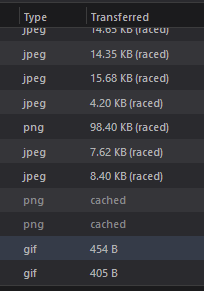
There are four possible values for the Transferred column: 1) `13.2 KB` - a number saying how much data were transferred over the wire (perhaps compressed) 2) `cached` - a labels saying that the request came from the cache 3) `13.2 KB (raced)` - request is racing. The response was fetched from the server even if it's available in the cache. It was faster to get it from the server. 4) `cached (raced)` - request is racing. The response was fetched from the cache, but a request has been also sent to the server. The cache was faster in this case.
Emoñe’ẽ ko mbohavái ejeregua reheve 👍 2Opaite Mbohovái (3)
Ñemoĩporã poravopyre
The Race Cache With Network (RCWN) feature in Necko adds the ability to race the cache with the network when the cache is slow. So if reading from the disk is slow, we will send a network request, and return the channel from the network, even though we have the entry in the cache. This way we provide the content to consumers faster.
There are four possible values for the Transferred column: 1) `13.2 KB` - a number saying how much data were transferred over the wire (perhaps compressed) 2) `cached` - a labels saying that the request came from the cache 3) `13.2 KB (raced)` - request is racing. The response was fetched from the server even if it's available in the cache. It was faster to get it from the server. 4) `cached (raced)` - request is racing. The response was fetched from the cache, but a request has been also sent to the server. The cache was faster in this case.
Moambuepyre TyDraniu rupive
Great and detailed answer. Thank you very much.
What is the size of your disk cache as listed on the about:cache page?